
Home » ETRM – Energy Trading and Risk Management.
Advanced Energy Trading & Risk Management (ETRM)
Master India’s Power Markets — From IEX Fundamentals to Advanced Trading Strategies, Risk Management & Regulatory Frameworks.
April 2026
English
Premium
Access trending courses in Renewable Energy Industry.
4.8
(359 ratings)
946+
enrolled
OFFER ENDS IN 14 DAYS
This pricing is valid for a limited time only. The course will return to its standard price once this window closes.
₹4,999
₹9,999
Secure your spot now. Supporting line: Over 946+ learners have already enrolled.
OFFER ENDS SOON.
This pricing is valid for a limited time only. The course will return to its standard price once this window closes.
₹6,999
₹9,999
Secure your spot now. Supporting line: Over 946+ learners have already enrolled.
Learning outcomes
- Understand how Indian Power Exchanges (IEX, PXIL) operate — including Day-Ahead, Term-Ahead, Real-Time, and Green Markets.
- Master price clearing mechanisms, bidding strategies, and settlement processes in power trading.
- Navigate cross-border and inter-regional energy trade frameworks within the Indian grid context.
- Apply demand and supply fundamentals and price forecasting techniques used by real trading desks.
- Quantify and manage market risk, credit risk, and operational risk in energy trading portfolios.
- Understand Renewable Energy (RE) markets — RPO compliance, green certificates, and RE procurement strategies.
- Execute physical delivery and scheduling — Open Access, DSM, and Grid Code compliance.
- Implement advanced trading strategies including arbitrage, spread trading, portfolio optimization, and algorithmic trading.
- Decode India's complete regulatory framework — CERC, SERC, MERC, MBED, and upcoming policy trends.
- Crack interviews at energy companies, trading firms, utilities, and ETRM consulting organizations.
Course learning highlights
IEX Markets
Energy Trading
Risk Management
ETRM Fundamentals
This course includes
- 30+ Hours of On-Demand Video
- 30 Articles and In-Depth Readings
- 10 Real-World Case Studies
- 10 Weekly Quizzes
- 10 Downloadable PPT Sets
- GARP ERP Part 1 Sample Papers — 2017 to 2020
- Curated Energy Industry Podcast Videos
- ETRM Interview Preparation Module
- Resume Building Guide for ETRM Roles
- 1 Capstone Project
- End-Term Final Assessment
- Certificate of Completion
Why join this course?
13 Sections · 64+ Lessons · 30+ Hours
Power Market Fundamentals & Global Context
Session 1.1: Electricity as a Unique Commodity
Session 1.2: Global Power Market Evolution
Indian Power Exchange Mechanisms — Part 1
Module 2A: Day-Ahead and Term-Ahead Markets
Session 2.1: Day-Ahead Market Deep Dive
Session 2.2: Term-Ahead Market and Trading Platform Overview
Indian Power Exchange Mechanisms — Part 2
Module 2B: Real-Time & Green Markets
Session 3.1: Real-Time Market (RTM)
Session 3.2: Green Markets
Cross-Border & Regional Trading
Module 3: Inter-Regional and International Power Trade
Session 4.1: Indian Regional Grids and Congestion
Session 4.2: Cross-Border Trade Framework
Price Forecasting & Fundamental Analysis
Module 4: Forecasting and Market Analytics
Session 5.1: Demand and Supply Fundamentals
Session 5.2: Price Forecasting Techniques
Risk Management in Power Trading
Module 5: Trading Risk Management
Session 6.1: Market and Credit Risk
Session 6.2: Operational and Regulatory Risk
Renewable Energy Trading & Contracts
Module 6: RE Markets and Compliance
Session 7.1: RPO Framework and Compliance
Session 7.2: RE Procurement and Trading Strategies
Physical Delivery & Scheduling
Module 7: Scheduling and Grid Operations
Session 8.1: Scheduling Process and Open Access
Session 8.2: DSM and Grid Code Compliance
Advanced Trading Strategies
Module 8: Sophisticated Trading Techniques
Session 9.1: Arbitrage and Spread Trading
Session 9.2: Portfolio Optimization and Algo Trading
Regulatory Framework & Policy Analysis
Module 9: Regulations and Policy Landscape
Session 10.1: Regulatory Hierarchy and Key Regulations
Session 10.2: Emerging Policy Areas and Future Trends
Capstone Project
Option 1: Trading Strategy Development
Option 2: Price Forecasting System
Option 3: Market Analysis & Research Report
Option 4: Policy Impact Assessment
Option 5: Technology Implementation
Final Assessment
End-Term Assessment — Comprehensive examination covering all modules
GARP ERP Question Bank — Part 1 (Physical Markets)
GARP ERP Part 1 Sample Paper — 2019
GARP ERP Part 2 Sample Paper - 2018
GARP ERP Part 2 Sample Paper - 2017
Energy Industry Podcasts
How niche ETRM software providers are shaping the future of energy risk management — ETRM Mini-Series with Previse Systems — Ep. 1
How real-time risk visibility is transforming trading desk operations — ETRM Mini-Series with Beacon — Ep. 2
How short-term power and gas trading is managed end-to-end in a modern ETRM — ETRM Mini-Series with Brady — Ep. 3
How cloud-native CTRM-as-a-Service is making ETRM accessible for mid-size energy firms — ETRM Mini-Series with CTRMCloud — Ep. 4
How commodity trading firms select, implement, and scale ETRM platforms — ETRM Mini-Series with CTRM Cubed — Ep. 5
How modern ETRM design is shifting toward real-time PnL and position reporting — ETRM Mini-Series with Molecule — Ep. 6
How energy scheduling, nominations, and logistics are managed within ETRM systems — ETRM Mini-Series with PSI — Ep. 7
How front-to-back trade lifecycle management works across physical and financial energy markets — ETRM Mini-Series with Contigo — Ep. 8
How large-scale ETRM implementations are structured and delivered across global energy firms — ETRM Mini-Series with FIS — Ep. 9
How digital transformation and AI are being integrated into ETRM platforms — ETRM Mini-Series with Hitachi — Ep. 10
How carbon trading and renewables are being incorporated into next-generation ETRM systems — ETRM Mini-Series with Gen10 — Ep. 11
How enterprise portfolio management and holistic commodity risk is handled at scale — ETRM Mini-Series with ION Commodities — Ep. 12
How ETRM implementations are scoped, managed, and delivered from a consultancy perspective — ETRM Mini-Series with Inatech — Ep. 13
How trading firms evaluate and migrate between ETRM platforms without disrupting operations — ETRM Mini-Series with Enuit — Ep. 14
How the ETRM vendor landscape is evolving and what buyers should look for in a modern system — ETRM Mini-Series with Topaz — Ep. 15
ETRM Interview Preparation
What is ETRM and how does it differ from CTRM?
Walk me through the full life cycle of an energy trade — from deal capture to settlement.
What is the difference between a physical trade and a financial trade in the energy context?
Explain the difference between a forward contract and a futures contract.
What is an energy swap? Give an example of how a power producer might use one.
What is basis risk and why does it matter in energy trading?
What is a Power Purchase Agreement (PPA) and what are its key commercial components?
Explain mark-to-market (MtM) and why it matters in a trading book.
What is Value at Risk (VaR)? How is it calculated and what are its limitations?
Explain the difference between Day-Ahead, Term-Ahead, and Real-Time markets on IEX.
What is Open Access in the Indian power sector and what are its different categories?
What is Deviation Settlement Mechanism (DSM) and how does it work?
What is MBED and what are its implications for power trading in India?
What are the main categories of risk in an energy trading firm?
How does a trading firm manage counterparty credit risk?
What distinguishes a hedge from speculation?
Explain a costless collar strategy and when a producer would use it.
What is cross-hedging? Give an energy-specific example.
What is an Exchange Futures for Physicals (EFP) and when is it used?
What ETRM systems are you familiar with? (OpenLink Endur, Allegro, RightAngle).
What is the role of the front, middle, and back office in an energy trading firm?
What is a deal capture system and what key fields does a trade ticket contain?
How does position management work in an ETRM system?
What is a PnL report and what does it tell a trading desk?
What is the difference between realized and unrealized PnL?
What is a price curve and how is it used in trade valuation?
How does the IEX Day-Ahead Market clearing process work?
What is the Green Term-Ahead Market on IEX and who participates in it?
What is RPO and how does it affect procurement decisions?
Explain the role of CERC and SERC in India's power sector regulation.
What is the difference between inter-state and intra-state power trading in India?
A counterparty defaults on a physical delivery contract — walk me through the steps you would take.
How do you stay updated on energy market developments?
Where do you see India's power market heading in the next five years?
Building Your E/CTRM Resume — Tips and Tricks
Write a strong 2–3 line summary that references your ETRM background and this course specifically.
Use correct industry terminology: mark-to-market, position management, deal capture, VaR, CFaR, PnL, Open Access, DSM, RPO, counterparty risk, trade life cycle, settlement.
Quantify everything — volumes managed, trades supported, efficiency gains achieved.
Separate your skills section into: ETRM Systems / Market Knowledge / Risk & Financial / Regulatory / Tools.
Only list systems you can speak to in an interview — Endur, Allegro, RightAngle, SOLARC.
Name specific modules completed in this course under your certifications section — not just the course title.
Tailor every application to mirror the exact language of the job description.
Keep format clean: 1–2 pages, no tables or graphics that break ATS systems.
Recommended order: Summary → Experience → Education & Certifications → Skills → Additional
Do not use the same resume for every application.
Keep your LinkedIn profile consistent with your resume and up to date.
Requirements
• Proficiency in the English Language
• No prior trading or finance background required — the course begins from fundamentals
• A basic awareness of electricity or energy markets is helpful but not mandatory
• Curiosity and commitment to engage with the structured programme
Who this course is for
- Business Analysts and Consultants involved in the energy or ETRM industry who want to extend their domain knowledge and speak confidently about power market operations and risk.
- Financial Analysts who want to understand the nature of market, credit, and operational risks within energy and commodity firms.
- ETRM Analysts and Consultants looking to demonstrate nuanced, practical knowledge of India's power exchange and trading systems to clients and employers.
- Junior Power Traders who want early access to the strategic and technical knowledge that senior traders typically build over years on the desk.
- Trade Support Staff who want to understand what is happening behind the screens and apply more critical thinking to trade processes, documentation, and settlements.
- Energy Job Candidates preparing for interviews at power utilities, trading companies, IPPs, or ETRM consulting firms.
- Engineering and MBA Students currently pursuing or planning a career in the energy, power, or commodity supply chain sector.
- RE and Clean Energy Professionals who want to navigate RPO compliance, green energy markets, and renewable procurement strategies more confidently.
- Teachers and Faculty who want to demonstrate real-world energy trading examples within their academic curriculum.
- ETRM Interview Candidates preparing for contractor or full-time roles — use this to rapidly recap concepts and communicate them fluently.
Career Track as an Energy Trader
Track 1
Energy Analyst / Trade Support Role.
Energy Analyst, Power Procurement Analyst, Trade Operations Analyst Experience: 0–3 years Annual CTC (India): ₹7.3L – ₹12.9L Source: Glassdoor India.
Track 2
Power Trader / ETRM Consultant Role.
Real-Time Power Trader, ETRM Business Analyst, Energy Trading Analyst, Energy Consultant Experience: 3–7 years Annual CTC (India): ₹14L – ₹18L average Source: Glassdoor India.
Track 3
Senior Trader / Head of Trading / Principal Consultant Role.
Senior Power Trader, Head of Energy Trading, Principal ETRM Consultant Experience: 8+ years Annual CTC (India): ₹25L – ₹40L+ Source: Glassdoor India
Course Description
Energy is more important than ever right now.
Some economists argue that the GDP of a country is directly proportional to its energy consumption. The global population is projected to reach nearly 10 billion people by 2050. This will place enormous demands on energy globally — requiring leaner and more efficient supply chains, a diversified energy portfolio mix, and stricter environmental and regulatory controls. The result is a surging need for specialists with deep domain knowledge in the energy space, professionals who can help our planet navigate some of its most critical challenges and accelerate the transition into the new-energy age.
India sits at the center of this transformation. The country is rapidly transitioning toward a market-clearing, price-responsive power system — driven by the growth of Indian Power Exchanges (IEX, PXIL), the rise of renewable energy, real-time markets, and evolving regulatory frameworks like MBED. The professionals who understand how to operate within this ecosystem — how to read price signals, manage risk, navigate the grid, and structure energy contracts — will be among the most valuable in the industry.
This course is specifically designed to give you a structured, practical, and comprehensive understanding of India's power markets and the global ETRM (Energy Trading and Risk Management) space. We have broken down complex trading and risk concepts into digestible, logically sequenced modules — so whether you are a fresh graduate entering the sector, an analyst looking to upskill, or a professional preparing for interviews or new responsibilities, this course meets you where you are.
Instructors

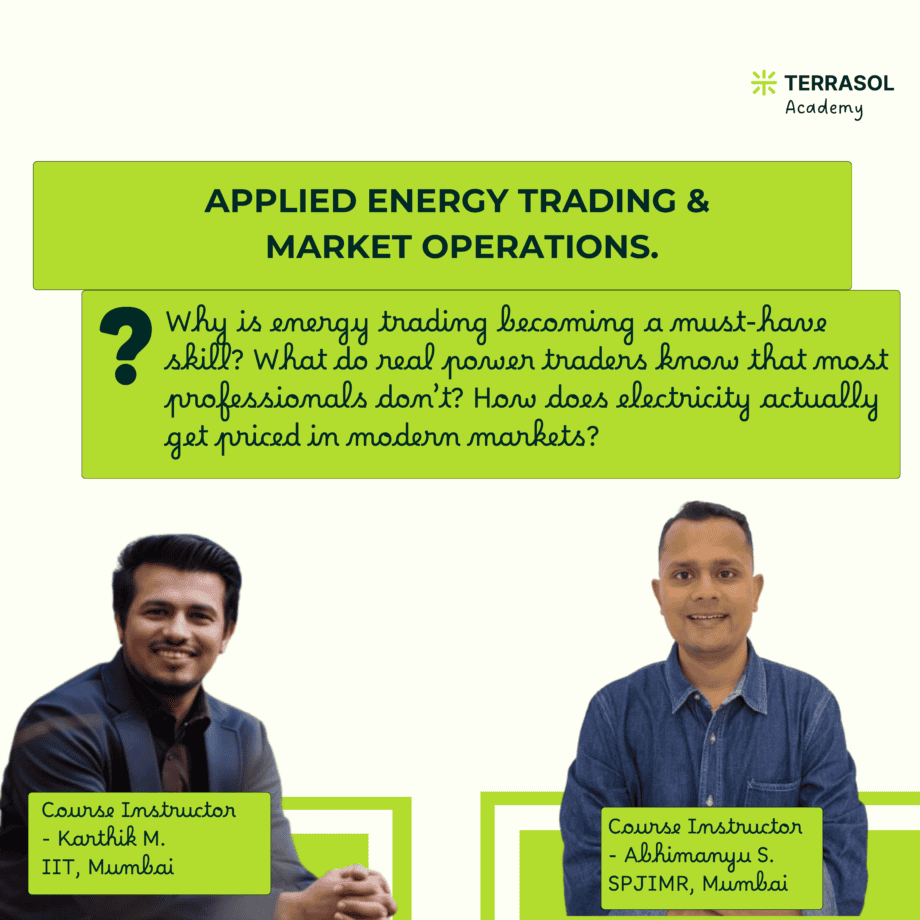
Abhimanyu Singh Rathore
MBA – SPJIMR Mumbai
Industry Experience: Waaree Energies, Enerparc Energy
- Market analysis & price forecasting
- Energy trading fundamentals
- RE procurement strategy
India is transitioning into a market-clearing, price-responsive power system. The winners will be those who understand how to interpret marginal prices, costs, risk, and volatility — and how to convert them into trading decisions.

Karthik M. Bhat
M.Tech – IIT Bombay
Industry Experience: Rakuten, Cyient
- Market analysis & price forecasting
- Energy trading fundamentals
- RE procurement strategy
Trading is fundamentally a data problem. As India moves toward MBED and higher renewable penetration, the need for analysts who can model uncertainty and build robust dispatch logic is greater than ever.
- 4.8 out of 5 · 359 Ratings · 946+ Students

Rohan M
Power Procurement Analyst
This course filled a massive gap in my understanding of how India’s power exchanges actually function. The case study on the 2022 summer price spike was unlike anything I have seen in any other course — incredibly well-researched and directly relevant to what actually happens in the market.
Priya S.
Junior Energy Trader
“I cleared my NTPC interview after completing this programme. The sections on RTM and DSM are incredibly detailed and directly applicable to real grid operations. Having this structured background made all the difference in technical rounds.
Karan T.
ETRM Consultant
The cross-border trading module covers something I could not find in any other Indian course. Both instructors have genuine skin in the game — you can feel the real-world experience behind every session, not just textbook theory.
OFFER ENDS SOON.
This pricing is valid for a limited time only. The course will return to its standard price once this window closes.
₹9,999
Secure your spot now. Over 946+ learners have already enrolled.