


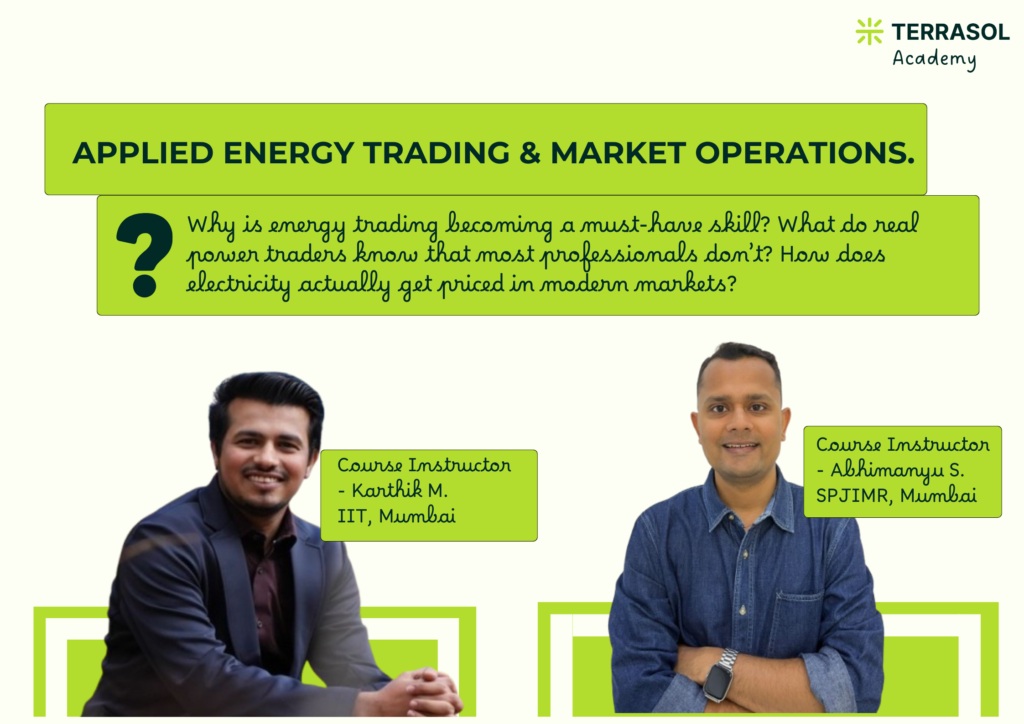


Applied Energy Trading
& Market Operations
30 Hours | Self Paced Online
Built by alumni from
Industry-Led Instruction
Learn directly from practitioners with a combined $1B+ experience across power trading, procurement, and market operations.
Real Market Case Studies
Three case studies built on actual Indian power market events and price movements.
Capstone Trading Playbook
Build an end-to-end Trading Playbook covering strategy, bidding, risk, and settlement.
Market Launchpad Kit
DAM/RTM datasets, PPA templates, bid logs, DSM files, settlement formats, and forecasting models used by trading desks.
India is transitioning into a market-clearing, price-responsive power system. The winners will be those who understand how to interpret marginal prices, costs, risk, and volatility, and how to convert them into trading decisions.
Abhimanyu Singh Rathore
Course Instructor • MBA – SPJIMR Mumbai
- Waaree Energies
- Enerparc Energy
Trading is fundamentally a data problem. As India moves toward MBED and higher renewable penetration, the need for analysts who can model uncertainty and build robust dispatch logic is greater than ever.
Karthik M. Bhat
Course Instructor • M.Tech – IIT Bombay
- Rakuten
- Cyient
Why India needs more power traders?
India’s electricity market is becoming faster, more volatile, and more market-driven. Skilled power traders are critical to manage price risk, integrate renewables, and ensure efficient power procurement in real time.
Detailed learning outcomes
Applied Energy Trading & Market Operations
An advanced course focused on developing professional energy traders with a global market perspective.
01
Advanced Price Forecasting
Build and interpret DAM/RTM forecasting models using market and system signals.
02
Landed Cost & Charges Modelling
Construct landed cost frameworks covering DSM, UI, POC charges, losses, and grid availability.
03
Systematic Bidding Strategies
Design and execute logic-driven bidding strategies across DAM, RTM, and TAM.
04
Strategy Backtesting & P&L
Backtest strategies on historical IEX data and compute detailed P&L attribution.
05
Risk & Exposure Management
Apply VaR, margin planning, and exposure mapping to manage trading risk.
06
PPA & Merchant Revenue Modelling
Model PPAs with merchant exposure and build blended revenue curves.
07
Market Operations Workflows
Run end-to-end DSM reconciliation, settlement, invoice mapping, and exception reporting.
08
Global Power Market Insights
Compare US LMP, EU zonal, and Australia’s co-optimised markets to assess India’s trajectory.
09
End-to-End Trading Playbook
Deliver a complete Trading Playbook spanning forecasting, bidding, risk, and post-trade analytics.
Week-wise technical curriculum (30 hours)
Video Lessons
Concept-led video modules for structured learning.
Curated Readings
Selected materials to reinforce concepts and market context.
Practice Quizzes
Ungraded quizzes to test understanding without pressure.
Graded Assignments
Evaluated assignments focused on applied learning.
Simulation Exercises
Hands-on market simulations to apply strategies in live-like conditions.
Case Studies
Real-world global energy trading cases analysing price movements, market events, and trading decisions.
Week 01
Foundations of India’s power market data structures and price formation.
Topics
- 15-minute block data, DAM block orders, RTM 30-minute auctions
- Market coupling constraints and congestion impact
- Renewable intermittency and system load curves
- Demand elasticity, ramping periods, and volatility regimes
Learning Activities
- Video lessons
-
Curated readings:
• CERC DSM 2022 Revision Guidelines
• IEX Market Bulletin on price spikes
Assessments
- Ungraded Quiz: Block order interpretation, price anomaly identification
-
Graded Assignment 1:
• Build a price driver dashboard using demand, weather, renewable injection, and congestion data
• Submission: Excel model + dashboard explanation note
Week 02
Cost construction and understanding of exchange-traded power market products.
Topics
- SLDC scheduling processes
- POC charges, losses, OA charges, CSS, AS charges
- Banking limits and cost implications
- DAM clearing algorithm (MCP/LCP interpretation)
- RTM 30-minute double auction
- TAM weekly contracts and peak/off-peak blocks
- Green markets: GDAM and GTAM
Learning Activities
- Build a multi-scenario landed cost workbook
- Sensitivity analysis for ±20% supply/demand shocks
Assessments
- Ungraded Quiz: Market product classification, price–volume clearing
-
Graded Assignment 2:
Complete a landed cost model including DSM deviations using sample DSM files
Week 03
Designing, testing, and evaluating systematic trading strategies.
Topics
- Mean-reversion vs momentum strategies for DAM
- Volatility breakout strategies for RTM
- Spread strategies: DAM–RTM, peak–off-peak, block–block
- Probabilistic bid curve construction
- Backtesting methodology (slippage, rejected bids, partial clears)
Learning Activities
- Trading simulation using historical market data
- Reading: Corporate RTM procurement during a peak heatwave event
Assessments
- Ungraded Quiz: Strategy classification, P&L interpretation
-
Graded Assignment 3:
Backtest a custom strategy with P&L attribution and justification
Week 04
Managing financial risk and executing bids in exchange markets.
Topics
- Value-at-Risk (VaR) for power markets
- Exposure mapping across DAM, RTM, and TAM
- Exchange margin requirements
- Cashflow cycle management
- Bid stack modelling (ladder vs curve bids)
- Block order optimisation
- Price cap and floor mechanics
- MCP prediction uncertainty
Learning Activities
- Build a VaR calculator using historical returns
- Stress testing for blackout events, renewable dips, and demand surges
Assessments
- Ungraded Quiz: Valid bid structures, bid matching
-
Graded Assignment 4:
• Create a bid pack for one DAM day and ninety minutes of RTM
• Reconcile results with simulated MCP outcomes
Week 05
Revenue modelling and operational settlement workflows.
Topics
- PPA structures: fixed, escalating, discount, floor–ceiling
- Merchant exposure modelling
- Blended revenue curve construction
- Curtailment-adjusted yield estimation
- DSM report parsing
- Overdrawal and underdrawal exception management
- Invoice reconciliation workflows
- Forecast error reporting templates
Learning Activities
- PPA and merchant revenue modelling exercises
- DSM reconciliation using sample settlement data
Assessments
-
Graded Assignment 5:
• Build a PPA + merchant blended revenue model for a 50 MW solar plant
Week 06
Global power market design and integrated application of learning.
Topics
- PJM LMP and FTR mechanisms
- Nord Pool zonal architecture and market coupling
- CAISO real-time dispatch and renewable curtailment
- Australia NEM co-optimised dispatch (energy + FCAS)
Learning Activities
- Comparative analysis of global market structures
Assessments
- Ungraded Quiz: Global market design mapping
-
Capstone Project (Graded):
• Build a complete Trading Playbook covering forecasting, strategy, bidding, risk assessment, and P&L attribution
Frequently Asked Questions
FAQs
Still have a questions?
Who can benefit from this course?
This course is suitable for professionals, graduates, and learners who work with markets, data, or commercial decision-making. It is relevant for power sector professionals, renewable energy developers, corporate power buyers, analysts, consultants, finance teams, and individuals from stock or commodity market backgrounds.
Can someone from a stock market or trading background take this course?
Yes. Participants with experience in equities, commodities, or derivatives often adapt quickly because concepts such as auctions, price discovery, volatility, risk–reward trade-offs, and P&L attribution are familiar. The course focuses on the unique aspects of electricity markets, including grid constraints, settlement logic, and regulatory frameworks.
Is prior power sector experience required?
No. The course begins with market data structures and price drivers and gradually moves into advanced modelling and strategy. While power sector exposure is helpful, it is not mandatory.
Is the course live or self-paced?
The course is primarily self-paced. All core content is available through recorded video lessons, readings, datasets, and exercises.
How long will I have access to the course?
You will have full access to the course content for 6 months from the date of enrolment.
How much time should I expect to spend on the course?
On average, learners spend 4–6 hours per week, including video lessons, hands-on modelling, quizzes, and assignments. The capstone project may require additional focused effort.
Is the course theoretical or practical?
The course is strongly application-focused. You will build forecasting models, landed cost frameworks, bidding strategies, risk models, and settlement reconciliations using real-world market datasets. Theory is introduced only to support practical execution.
What tools or software are required?
You will primarily need Microsoft Excel or Google Sheets. All required datasets, templates, and simulation inputs are provided. No proprietary trading software is required.
Will I work with real Indian power market data?
Yes. The course uses historical DAM, RTM, DSM, and settlement datasets that closely reflect real Indian market conditions, curated specifically for learning and modelling purposes.
Does the course cover both trading and procurement use cases?
Yes. The course covers merchant trading, corporate procurement, landed cost optimisation, PPA modelling, RTM procurement strategies, and risk management.